What is a Switching Power Supply and How Does It Work?
A Switching Power Supply (SPS) is a critical component in modern electronics. It converts electrical power efficiently. By using high-frequency switching, it reduces energy losses. This technology is everywhere—from chargers to complex computers.
Understanding how a Switching Power Supply operates is essential. It involves several key components like transistors, inductors, and capacitors. Each part has its role, but the overall efficiency can vary. Many users overlook this aspect, seeking performance without considering efficiency.
In practice, not all Switching Power Supplies are created equal. Factors like load conditions and ambient temperature affect their performance. Users may find that a less efficient model leads to overheating or shorter lifespan. Therefore, choosing the right SPS requires careful thought and analysis.
What is a Switching Power Supply and Its Importance in Modern Electronics
Switching power supplies play a crucial role in modern electronics. They convert electrical energy efficiently, which is essential for powering various devices. According to a report by MarketsandMarkets, the global switching power supply market is projected to reach $35 billion by 2025, driven by the growing demand for energy-efficient technologies. This growth indicates how significant these power supplies have become in electronic design.
One key aspect is their compact size. They often replace traditional linear power supplies, offering similar functionality in a smaller footprint. This characteristic is vital for handheld devices and wearables, where space is limited. However, they are not without challenges. Switching power supplies generate electromagnetic interference, which can affect nearby components. Designers must consider this when integrating these systems into their projects.
Another point of concern is heat generation. Although switching power supplies are efficient, they still conduct some energy as heat. A study from the Electric Power Research Institute highlighted that thermal management is crucial to ensure longevity and reliability of electronic devices. As technology advances, it’s critical to re-evaluate these designs, continually finding ways to minimize drawbacks while maximizing performance.
Key Components of a Switching Power Supply: An Overview
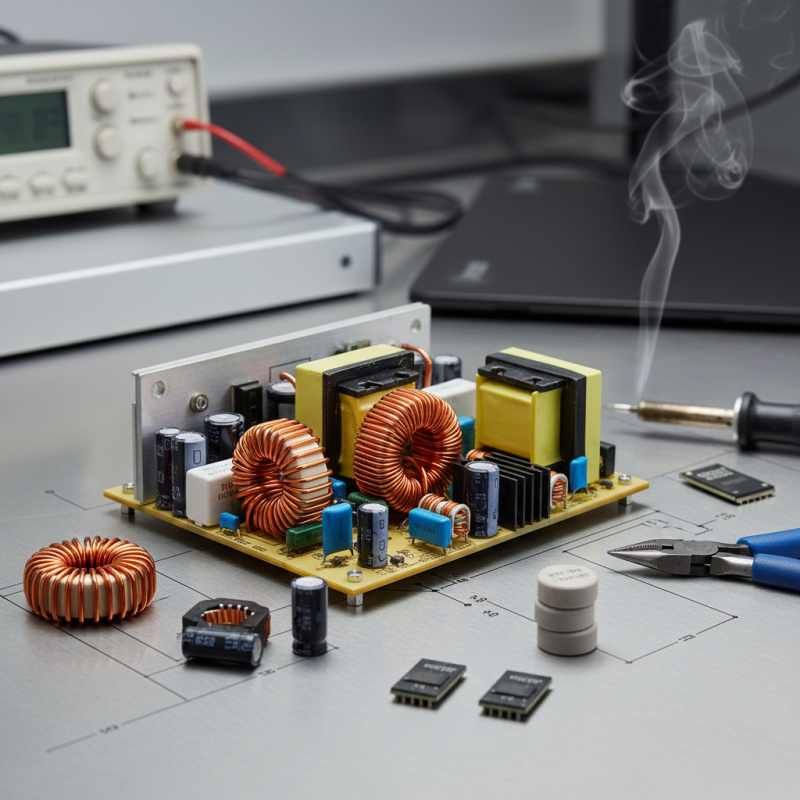
Switching power supplies, commonly used in various electronic devices, rely on essential components to function effectively. The heart of these systems is the transformer. It steps the voltage up or down as needed. This allows the supply to provide different voltage levels for various applications. Additionally, inductors play a critical role in storing energy. They help regulate the energy flow, ensuring stable output during operation.
Another key component is the switching element, often a transistor. This element controls power flow with great efficiency. It rapidly alternates between on and off states, minimizing energy loss. Capacitors are essential too. They filter and smooth out the output voltage. Without them, devices would suffer from fluctuations and noise.
While these components work well together, they aren't without challenges. For example, electromagnetic interference (EMI) can occur due to the rapid switching. This can affect nearby circuits. Designers often need to use shielding techniques to tackle this issue. Balancing efficiency and stability remains a constant consideration. Careful planning is essential to create a reliable switching power supply.
How a Switching Power Supply Converts Voltage: The Basic Principles
A switching power supply is essential in many electronic devices. Its main job is to convert voltage efficiently. The process involves a few key principles that make it versatile and effective.
At the heart of the switching power supply is a series of switches and transformers. These components rapidly turn on and off, cutting power during specific intervals. This action reduces energy loss, unlike traditional linear power supplies. The input voltage is transformed and switched to create a new voltage level. A diode helps to rectify the output, ensuring a steady supply.
Feedback loops play a crucial role in maintaining voltage stability. When the output voltage fluctuates, these loops adjust the switching frequency. It can be a bit complex. Sometimes, if the feedback isn’t tuned correctly, it can lead to inefficiencies. Users might notice slight variations in output. Attention to these details can lead to better performance and reliability.
Efficiency Metrics of Switching Power Supplies: An Industry Perspective
Switching power supplies are essential in modern electronics. They convert electrical energy from one form to another efficiently. However, their efficiency metrics vary significantly across the industry. Understanding these metrics can guide engineers in selecting the most suitable power supply for their applications.
One critical metric is the efficiency percentage. This figure indicates how much input power is converted to output power. A higher efficiency means less wasted energy, reducing heat generation. For instance, a power supply operating at 90% efficiency wastes only 10% of its input power. Yet, achieving high efficiency can be challenging. Factors like load conditions and temperature can impact performance.
Another important aspect is power factor. It measures how effectively the power supply uses its input power. A low power factor can lead to higher energy costs and regulatory penalties. Many manufacturers strive for a power factor close to unity. However, real-world conditions often hinder this goal. Engineers must consider both efficiency and power factor in their designs for a balanced approach.
Applications and Trends in Switching Power Supply Technology Today
Switching power supplies (SPS) are vital in modern electronics. Their applications are broad, ranging from consumer electronics to industrial machinery. According to a report by Mordor Intelligence, the global market for switching power supplies is projected to grow at a CAGR of 6.9% from 2020 to 2025. They are preferred for their efficiency and compact size.
These power supplies can achieve over 90% efficiency, which reduces energy waste. This efficiency is crucial given the increasing demand for energy-saving solutions. However, challenges remain, such as electromagnetic interference (EMI). Mitigating EMI requires careful circuit design. Engineers need to focus on optimizing layout and component selection to handle this issue effectively.
Tips: Always consider the thermal management in your designs. Poor heat dissipation can lead to failures. Also, stay updated on emerging technologies in power supply designs. New materials are enhancing efficiency and reducing size. Despite advancements, many designs still struggle to meet the latest standards in EMI. Continuous improvement is necessary to keep up with changing regulations.
What is a Switching Power Supply and How Does It Work?
| Parameter | Description | Value |
| Input Voltage Range | The range of input voltages that the power supply can accept | 85-265 VAC |
| Output Voltage | The voltage that the power supply outputs to the load | 5 V, 12 V, 24 V |
| Efficiency | The ratio of output power to input power | Up to 90% |
| Switching Frequency | The frequency at which the power supply operates | 50 kHz - 1 MHz |
| Typical Applications | Common applications where switching power supplies are used | Computers, TVs, LED lighting, industrial equipment |
| Trends | Current trends in switching power supply technology | Miniaturization, improved efficiency, smart technology |