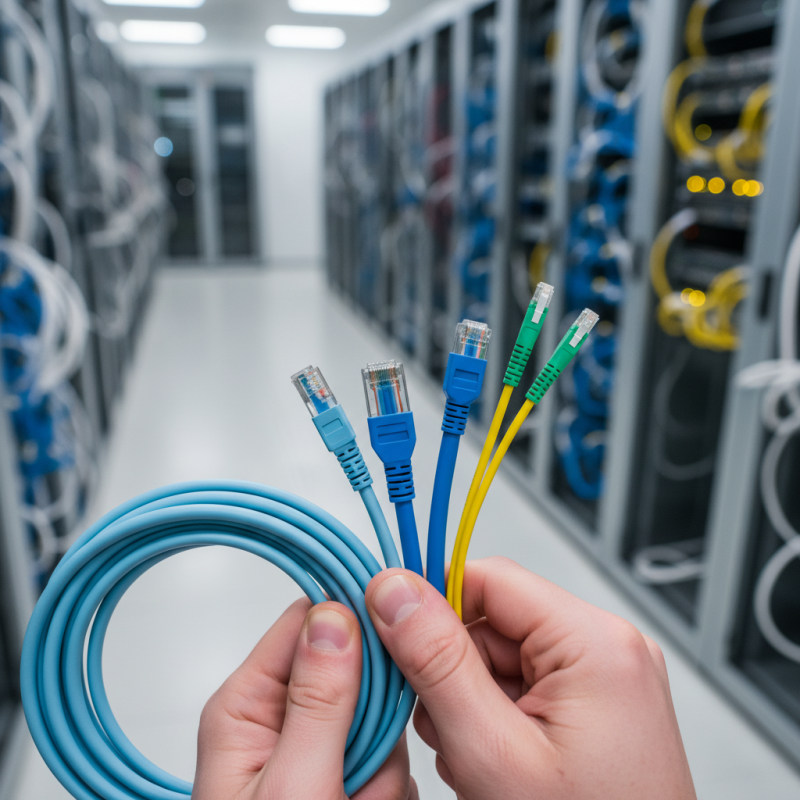
How to Choose the Right Network Cable for Your Needs?
Choosing the right Network Cable is essential for optimal connectivity. With numerous options available, making the right choice can be overwhelming. A suitable network cable improves speed and reliability for your specific requirements.
Factors such as cable type, distance, and environment play a crucial role. For instance, Ethernet cables like Cat5e and Cat6 support various speeds and bandwidths. However, not every option fits every situation. In some cases, an incorrect choice may lead to poor performance.
It’s also important to consider future needs. Technology evolves quickly, and a cable that seems ideal today may not meet tomorrow's demands. Taking the time to understand your needs will lead to a more effective solution. Don’t hesitate to seek expert advice when uncertain. Evaluating your requirements ensures you choose the most efficient network cable for your setup.
Understanding Network Cable Categories: From Cat5 to Cat8
When selecting the right network cable, understanding the different categories is crucial. Each category offers distinct capabilities that suit various needs. The most common types are Cat5, Cat5e, Cat6, Cat6a, Cat7, and Cat8. According to the Telecommunications Industry Association, Cat5 cables support speeds up to 100 Mbps. This may suffice for a small home network but falls short for demanding applications.
Cat6 cables provide a significant upgrade. They support speeds of up to 1 Gbps over a distance of 100 meters. This enhancement is ideal for most business environments. For those looking to future-proof their setup, Cat6a and Cat7 cables come into play. They handle speeds of 10 Gbps, enabling more efficient data transmission. Cat8 cables are the latest addition, reaching speeds of up to 40 Gbps over short distances. However, not all networks require such high performance, making Cat8 an overinvestment for many.
When choosing cables, consider installation conditions and potential interference. Higher categories often employ better shielding, which is vital in high-traffic areas. Data from industry reports indicate that businesses experience performance drops due to inadequate cabling. Reflection on such factors can lead to better network reliability. It's essential to weigh your current and future needs before making a decision.
Comparing Cable Types: Twisted Pair vs Coaxial vs Fiber Optic
When choosing the right network cable, understanding the differences between twisted pair, coaxial, and fiber optic cables is crucial. Twisted pair cables, such as Cat5e and Cat6, are widely used for Ethernet connections. They consist of pairs of wires twisted together to reduce interference. This type is cost-effective and efficient for short to moderate distances. However, it may not perform well in high-interference environments.
Coaxial cables, on the other hand, have a central conductor surrounded by insulation and shielding. They are typically used for cable television and broadband internet. Coaxial cables can transmit signals over long distances without significant loss. Yet, they are bulkier and can be more challenging to install in tight spaces. If your environment demands robust performance, coaxial might be your best bet.
Fiber optic cables offer superior speed and bandwidth. They use light to transmit data, making them less susceptible to interference. This type of cable is ideal for large-scale networks requiring high-speed data transfer. However, fiber optic installations can be expensive and complex. If you're considering fiber, ensure your budget and technical expertise align.
Tips: Always check your network's requirements before selecting a cable type. Consider factors like distance and environment. Assess future needs, as upgrading later can be costly. Don't be afraid to consult with professionals to avoid costly mistakes.
Evaluating Cable Length Requirements for Optimal Performance
When selecting the right network cable, evaluating cable length is crucial. The performance of your network can significantly be affected by the distance between devices. If the cable is too long, you may experience signal loss or a decrease in speed. For optimal performance, it’s essential to keep cable lengths within recommended limits to safeguard data integrity.
Generally, Ethernet cables perform best under specific length constraints. For standard Ethernet, a maximum length of 100 meters is advisable. Exceeding this distance can lead to issues like packet loss. Shorter runs, ideally under 30 meters, can maintain a high level of signal quality. It’s important to consider the layout of your space and the distance between devices when making your decision.
Sometimes, users overlook the impact of cable management. Tangled or poorly routed cables can introduce interference, impacting performance. Investigate your setup. Would a shorter, more optimized cable perform better than a longer one? Remember that the environment can play a role. Avoid running cables near power lines or other potential sources of interference. Consider all these factors carefully for the best results.
Assessing Environmental Factors: Indoor vs Outdoor Cable Choices
When selecting network cables, environmental conditions are crucial. Indoor and outdoor cables serve different purposes. Indoor cables typically use materials that aren't as weather-resistant. They are lightweight and flexible, ideal for structured cabling within buildings.
Outdoor cables, however, face harsher elements. They must withstand UV light, moisture, and temperature extremes. These cables often feature thicker jackets, shielding, and additional waterproofing. Consider these factors carefully when making your choice.
Tips: Always assess the installation area. If it’s exposed to sunlight or rain, prioritize outdoor-rated cables. Check for fire ratings and choose cables that comply with local codes. Planning for potential future uses can save you time and money in the long run. Remember, what works indoors may not suffice outdoors; don’t overlook these details.
Determining Bandwidth Needs: What You Need for Your Applications
When determining your bandwidth needs, consider how you'll use your network. Streaming HD videos or gaming requires more bandwidth compared to browsing websites or checking emails. Think about the number of devices connected at once. More devices mean higher bandwidth needs.
Tips: Analyze your regular activities. Count how many devices will connect. Assess the applications that demand high bandwidth.
Different applications have varying requirements. For example, video conferencing might need 1.5 Mbps per user. In contrast, large file transfers could call for even more. Often, people underestimate the bandwidth necessary for smooth operation. Over time, your needs may evolve too.
Tips: Avoid choosing cables based solely on speed. Think about future applications. Select cables that can handle growth without constant upgrades.
How to Choose the Right Network Cable for Your Needs?
| Cable Type | Max Bandwidth | Max Distance | Use Case |
| Cat 5e | 1 Gbps | 100 meters | Home Networking |
| Cat 6 | 10 Gbps | 55 meters | Gaming, Streaming |
| Cat 6a | 10 Gbps | 100 meters | Data Centers |
| Cat 7 | 10 Gbps | 100 meters | Professional Environments |
| Fiber Optic | Up to 100 Gbps | Up to several kilometers | Long-Distance Internet |